Spoken-recall training for Step 2 CK

Study by saying it, not by seeing it.

A board question is read to you, you answer in full sentences, and a grader reads your reasoning — not a self-rating. Right answer with wrong reasoning does not pass. It runs with the screen locked, so a walk becomes a review block.

Sign in

Closed beta — accounts are made by hand, one at a time. Study on the web, or hands-free on iPhone.

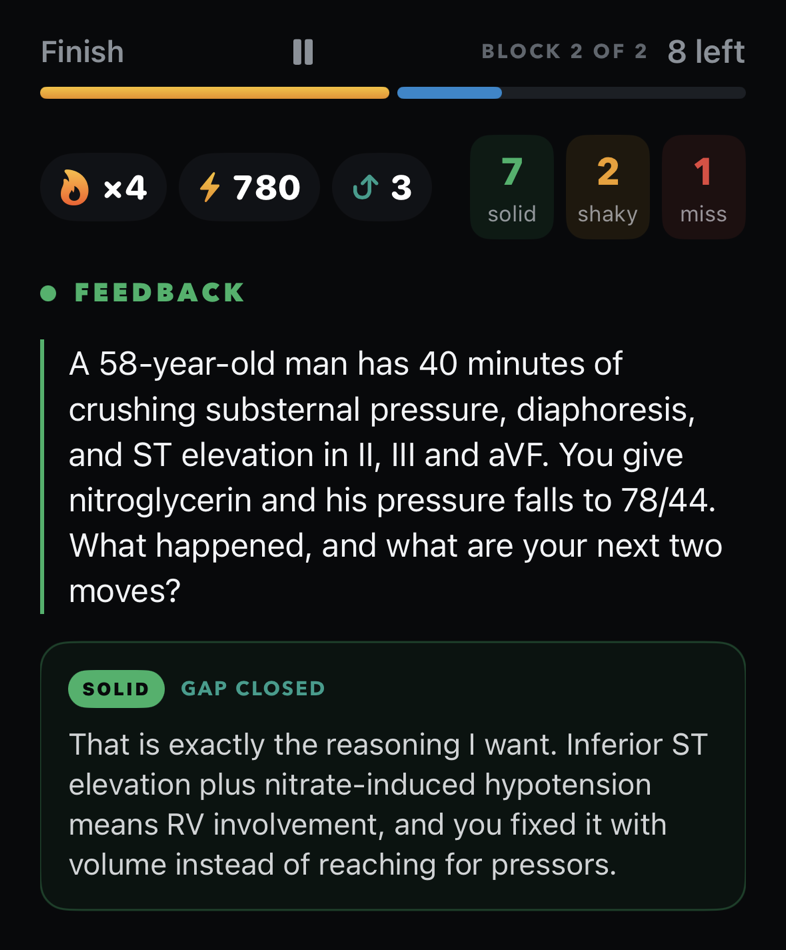
The PMPR session screen: a cardiology vignette, graded SOLID, with the feedback explaining why nitrate-induced hypotension points to right-ventricular involvement.
Mid-block, just after a graded answer

Asks

Six years of GERD, Barrett without dysplasia, three months of trouble swallowing solids. Barium swallow shows a symmetric, concentric narrowing of the distal esophagus. Most likely cause, and the definitive treatment?

You, out loud

“Barrett’s is progressing — I think this is adenocarcinoma of the distal esophagus. I’d scope him and biopsy it.”

Grade

Miss

Barrett is why you reached for cancer, but the barium finding decides it: malignant strictures are asymmetric and irregular. Symmetric and concentric is a peptic stricture — scarring, not dysplasia. Endoscopy is right, and it is also the treatment: dilation, plus high-dose PPI so it does not re-form.

Gap logged — “assumed malignancy from Barrett history, ignored stricture morphology”

You said something wrong on the way to a wrong answer, and it named the wrong thing you said.

Recognising an answer is not knowing it.

  • Esophageal adenocarcinoma
  • Peptic stricture
  • Achalasia

The answer is on the screen. You pick the one that feels familiar, or flip the card and decide you knew it — the judgement you are least able to make about your own gap.

“Peptic stricture — the narrowing is smooth and concentric, so it’s scarring, not tumour…”

Nothing to see and nothing to pick from. You retrieve the answer, say the reasoning, and something else decides. Retrieval is what strengthens the memory — and it is also what the exam actually tests.

One click while the explanation is still open.

Finish a question in UWorld or AMBOSS, hit Drill this, and say or type why you got it wrong. The extension keeps the two live candidates — the one you picked and the one that was right — and PMPR turns them into a spoken rule-out drill instead of a fact to re-memorise.

  • Captured content stays private to your account — enforced by the database, not a setting
  • Never shared, exported, or shown to another user

How to install it

Credits every month, on every plan.

Free

100 credits a month

The whole product — the full loop, the extension, the scheduler. Nothing is held back and nothing is a trial.

$5 a month

500 credits a month

Five times the free tier, for the price of a coffee. Fresh credits land on every renewal.

$10 a month Daily driver

1,000 credits a month

For dedicated study — blocks every day, and never a reason to think about the meter.

+500 credits for $5

Top up at any time, on any tier, as often as you like. Topped-up credits sit in your balance until you use them — the monthly credits are spent first, so nothing you paid for expires underneath them.

A graded typed answer costs about 2 credits. A spoken card also pays for transcription, and for speech unless you have downloaded the on-device voice — which is the default, is free to run, and is why a spoken card is nearer 3 credits than the 7 it used to be. Credits are what the models and the voice actually cost, at a flat 1 credit = 1¢.